Contents of this page: Scientific Overview, Organizers, Scientific Organizing Committee, Latest Status, Important Dates
Scientific Overview:
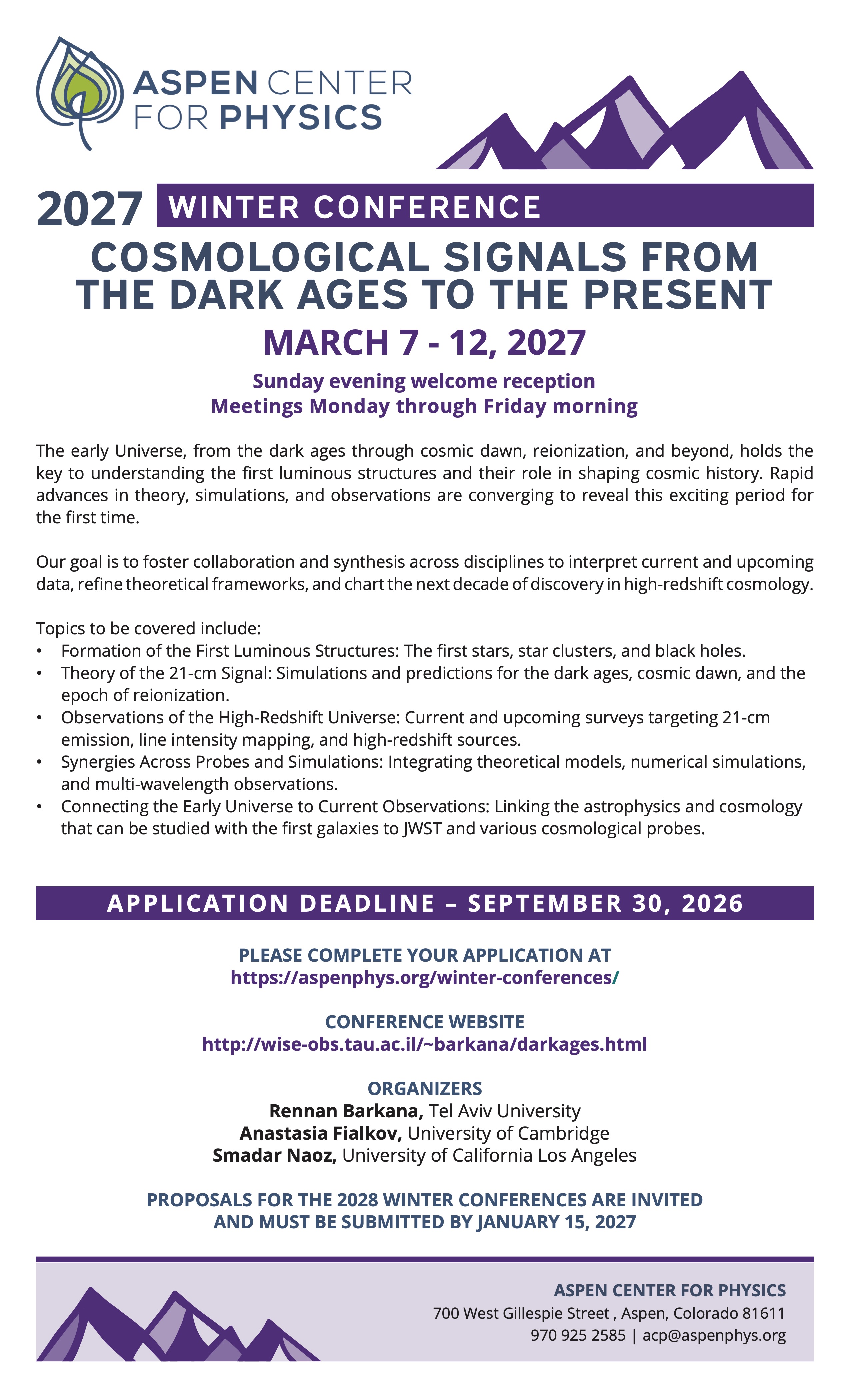
The early Universe, from the dark ages through cosmic dawn, reionization, and beyond, holds the key to understanding the first luminous structures and their role in shaping cosmic history. Rapid advances in theory, simulations, and observations are converging to reveal this exciting period for the first time.
Our goal is to foster collaboration and synthesis across disciplines to interpret current and upcoming data, refine theoretical frameworks, and chart the next decade of discovery in high-redshift cosmology.
Topics to be covered include:
- Formation of the First Luminous Structures: The first stars, star clusters, and black holes.
- Theory of the 21-cm Signal: Simulations and predictions for the dark ages, cosmic dawn, and the epoch of reionization.
- Observations of the High-Redshift Universe: Current and upcoming surveys targeting 21-cm emission, line intensity mapping, and high-redshift sources.
- Synergies Across Probes and Simulations: Integrating theoretical models, numerical simulations, and multi-wavelength observations.
- Connecting the Early Universe to Current Observations: Linking the astrophysics and cosmology that can be studied with the first galaxies to JWST and various cosmological probes.
Organizers:
Rennan Barkana [Webpage] (Tel Aviv University)
Anastasia Fialkov [Webpage] (University of Cambridge)
Smadar Naoz [Webpage] (University of California Los Angeles)
Scientific Organizing Committee:
Zoltan Haiman (Columbia University, Institute of Science and Technology Austria)Marc Kamionkowski (Johns Hopkins University)
Leon Koopmans (Kapteyn Astronomical Institute, University of Groningen)
Adrian Liu (McGill University)
Naoki Yoshida (University of Tokyo, Kavli IPMU)
Matias Zaldarriaga (Institute for Advanced Study)
Latest Status:
Conference (initial) registration ended on September 30, 2026. The Aspen Center for
Physics will soon notify applicants whether their participation has been approved. We will have
a poster session, and everyone is welcome to bring a poster. Regarding talks, we are now in the
process of going through the large number of talk requests. We hope to finish this process by
the end of October. The (final) conference registration deadline will be January 31, 2027. We do not know at
this point whether we will have any financial support to provide to participants. It will probably take
months until this is determined.
Here is a link to
the conference
listing at the Aspen Center for Physics.
Important Dates:
| September 30, 2026 | Deadline for (initial) registration (including abstract submission) |
| End of October, 2026 (estimated) | Talks determined |
| January 31, 2027 | Deadline for (final) registration |
| March 7-12, 2027 | Conference |